Wednesday, August 23, 2023

From "Bisclavret" by Marie de France, lines 1-14

From "Bisclavret" by Marie de France, lines 1-14

[Original text in Anglo-Norman]

Quant des lais faire m'entremet,
Ne voil ublier Bisclavret;
Bisclavret ad nun en bretan;
Garwaf l'apelent li Norman.

Jadis le poeit hum oïr
E sovent suleit avenir,
Hume plusur garval devindrent
E es boscages meisun tindrent.
Garwalf, ceo cest beste salvage;
Tant cum il est in cele rage,
Hummes devure, grant mal feit,
Es granz forez converse e vait.
Cest afere les ore ester;
Del islavret vus voil cunter.


[English translation by Dorothy Gilbert]

In crafting lays, I won't forget
—I mustn’t—that of Bisclavret;
Bisclavret: so named in Breton;
But Garwaf in the Norman tongue.

One used to hear, in times gone by
—it often happened, actually—
men became werewolves, many men,
and in the forest made their den.
A werewolf is a savage beast;
in his blood-rage, he makes a feast
of men, devours them, does great harms,
and in vast forests lives and roams.
Well, for now, let us leave all that;
I want to speak of Bisclavret.


Source of the text - Marie de France, Poetry (A Norton critical edition), translated and edited by Dorothy Gilbert.  New York: W.W. Norton & Company, 2015, pages 48-49.

TJB: Chatty, personable, singsong-y, the poet raises the subject of toxic masculinity—sorry, werewolves—and calls attention to changing subjects.


"Station" by Ishion Hutchinson


STATION


The train station is a cemetery.
Drunk with spirits, a man enters. I fan gnats
from my eyes to see into his face. “Father!”
I shout and stumble. He does not budge.
After thirteen years, neither snow nor train,
only a few letters, and twice, from a cell,
his hoarfrost accent crossed the Atlantic.
His mask slips a moment as in childhood,
pure departure, a gesture of smoke.


Along freighted crowds the city punished,
picking faces in the thick nest of morning’s
hard light that struck raw and stupid,
searching, and in the dribble of night commuters,
I have never found him, wandering the almond
trees’ shadows, since a virus disheartened
the palms’ blossoms and mother gave me the sheaves
in her purse so he would remember her
and then shaved her head to a nut.


I talk fast of her in one of my Cerberus
voices, but he laughs, shaking the scales
of froth on his coat. The station’s cold
cracks a hysterical congregation;
his eyes flash little obelisks that chase the spirits
out, and, without them, wavering, I see
nothing like me. Stranger, father, cackling
rat, who am I transfixed at the bottom
of the station? Pure echo in the train’s
beam arriving on its cold nerve of iron.


Source of the text – Ishion Hutchinson, House of Lords and Commons: Poems.  New York, Farrar, Straus & Giroux, 2017, p. 3-4.

TJB: In the station ie Hades, the poet sees the apparition of a father’s face in the crowd—that moment when you are nothing, & everything, like him.


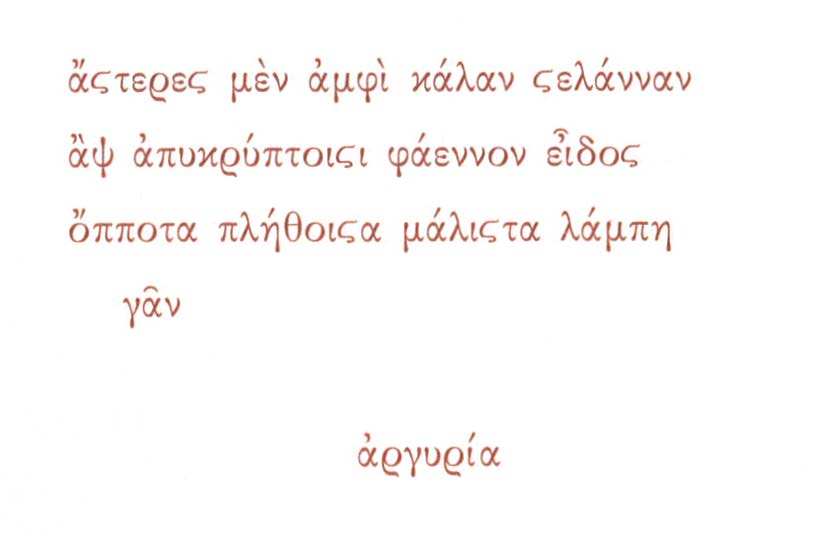
Untitled Lyric Fragment by Sappho

Untitled Lyric Fragment by Sappho

[Text of the poem fragment in the original Greek]


[Translation by Anne Carson]

34

stars around the beautiful moon
hide back their luminous form
whenever all full she shines
             on the earth

             silvery


Source of the text in Greek and in translation – Anne Carson, If Not, Winter: Fragments of Sappho.  New York: Alfred A. Knopf, 2002, pages 68-69.

TJB: Without a love of her own, the poet imagines her beloved as the full (pregnant?) moon, as a sort of bride, with stars as mere bridesmaids.


Friday, December 28, 2018

"Yard Work" by Sarah Maclay


Yard Work


I’ll clear the old, putrid fruit,
the carcasses of bees where oranges have fallen
and the drying turds the dogs have dropped.
I’ll sweep away the fallen avocado leaves
grown snowy with their infestations,
snip the stems of toppled flowers, toss them.
I’ll yank the hose across the grass,
turn the rusty faucet,
let the lawn moisten
to a loose, runny black.
I’ll water the rosemary
till I can smell it on my fingers.
Time to grab the trowel.
Time to dig,
to take off the gloves,
let the handle callous the palm,
fill the fingernails
with dirt.
Time to brush the trickle from the forehead.
Time to plant the bulb,
to fill the hole with loam and water,
covering the roots.
Time to join the soil to soil
until the night is jasmine
and a thickness like a scent of lilies
rises off the bed;
until the stalks of the naked ladies fall to the ground,
twisting on their roots;
until our broken fists lie blooming.


Source of the text – Sarah Maclay, Whore.  Tampa: University of Tampa Press, 2004, p. 61.

TJB: The poet’s squat pen rests, snug as a spade in this paratactic ars poetica where poetry entails digging and planting bulbs, not blossoming.


Wednesday, December 26, 2018

"Husband Sonnet One" by Lisa Jarnot


Husband Sonnet One


o calm sheep in the fields asleep

be quiet while my husband sleeps

ride bicycles or drive your jeeps

in pastures where the snow is deep

the roads that bend o pay no heed

nor wonder where the neighbor speeds

nor ponder at the road’s sad fork

just plow on forward brave and dark

like Dante in his mid-life’s wood,

a sheep’s mid-life is stout and good

like beer that ambers from a tap

or maple running wine tree sap

you sheep of silence play along

in dreams my husband sleeps among


Source of the text - Lisa Jarnot, Night Scenes.  Flood Editions, 2006.

TJB: Jeep for sale—cheap. Nodding at children’s verse, Frost’s diverging roads, & the path to hell, the poet finds quality time for married life.


"Tonight" by Agha Shahid Ali


Tonight
           Pale hands I loved beside the Shalimar
                                           —Laurence Hope


Where are you now? Who lies beneath your spell tonight?
Whom else from rapture’s road will you expel tonight?

Those “Fabrics of Cashmere—” “to make Me beautiful—”
“Trinket”—to gem—“Me to adorn—How tell”—tonight?

I beg for haven: Prisons, let open your gates—
A refugee from Belief seeks a cell tonight.

God’s vintage loneliness has turned to vinegar—
All the archangels—their wings frozen—fell tonight.

Lord, cried out the idols, Don’t let us be broken;
Only we can convert the infidel tonight.

Mughal ceilings, let your mirrored convexities
multiply me at once under your spell tonight.

He’s freed some fire from ice in pity for Heaven.
He’s left open—for God—the doors of Hell tonight.

In the heart’s veined temple, all statues have been smashed.
No priest in saffron’s left to toll its knell tonight.

God, limit these punishments, there’s still Judgment Day—
I’m a mere sinner, I’m no infidel tonight.

Executioners near the woman at the window.
Damn you, Elijah, I’ll bless Jezebel tonight.

The hunt is over, and I hear the Call to Prayer
fade into that of the wounded gazelle tonight.

My rivals for your love—you’ve invited them all?
This is mere insult, this is no farewell tonight.

And I, Shahid, only am escaped to tell thee—
God sobs in my arms. Call me Ishmael tonight.


Source of the text - Agha Shahid Ali, Call Me Ishmael Tonight: A Book of Ghazals.  New York: W. W. Norton & Company, Inc., 2003, p. 82-83.

TJB: 13 quips on faith and/or love. With juxtaposition & sharp metaphors, this ghazal gently celebrates itself, with a perfect ending on Ishmael.


Thursday, December 20, 2018

"Blind Tom Plays for Confederate Troops, 1863" by Tyehimba Jess


      BLIND TOM PLAYS FOR

CONFEDERATE TROOPS, 1863


      The slave’s hands dance free, unfettered, flying

      across ivory, feet stomping toward

      a crescendo that fills the forest pine,

      reminding the Rebs what they’re fighting for—

      black, captive labor. Tom, slick with sweat, shows

      a new trick: Back turned to his piano,

      he leans like a runner about to throw

      himself to freedom through forest bramble—

      until he spreads his hands behind him. He

      hitches fingertips to keys, hauls Dixie

      slowly out of the battered upright’s teeth

      like a work song dragged across cotton fields,

      like a plow, weighted and dirty, ringing

      with a slaver’s song at master’s bidding.


Source of the text – Tyehimba Jess, Olio.  Wave Books, 2016, p. 15.

TJB: Flow and staccato alternate in this sonnet of the surreal unforgettable narrative image of a slave playing his heart out to please the Rebs.


Wednesday, December 19, 2018

King Alfred's Verse Preface to his translation of Boethius's Consolation of Philosophy


Original Anglo-Saxon text:


Verse Preface


Ðus Ælfred us        eald-spell reahte,
cyning West-sexna,        cræft meldode,
leoð-wyrhta list.        Him wæs lust micel
ðæt he ðiossum leodum        leoð spellode,
monnum myrgen,        mislice cwidas,
þy læs ælinge        ut adrife
selflicne secg,        þonne he swelces lyt
gymð for his gilpe.        Ic sceal giet sprecan,
fon on fitte,        folc-cuðne ræd
hæleðum secgean.        Hliste se þe wille.


Translation into Modern English by Susan Irvine and Malcolm R. Godden:


Verse Preface


Alfred, King of the West Saxons,
told us an old story in this manner, made known his ability,
his skill as a poet. He had a great desire
to proclaim verse to these people,
entertainment for them, varied speeches,
lest tedium should drive away
the self-regarding man, when he pays little heed
to such a matter because of his pride. I must yet speak out,
engage in poetry, tell to men
well-known advice. Let him listen who will.


Source of the text – The Old English Boethius, with Verse Prologues and Epilogues Associated with King Alfred, edited and translated by Susan Irvine and Malcolm R. Godden. Cambridge, Mass.: Dumbarton Oaks Medieval Library, Harvard University Press, 2012, p. 4-5.

TJB: Selfie shtick. The poet-king speaks in third then first person, holding us spellbound with sonorous hypotactic speech, & dishing up wisdom.


Tuesday, December 11, 2018

"An Empty Garlic" by Jalâloddin Rumi


AN EMPTY GARLIC

You miss the garden,
because you want a small fig from a random tree.
You don’t meet the beautiful woman.
You’re joking with an old crone.
It makes me want to cry how she detains you,
stinking mouthed, with a hundred talons,
putting her head over the roof edge to call down,
tasteless fig, fold over fold, empty
as dry-rotten garlic.

She has you tight by the belt,
even though there’s no flower and no milk
inside her body.
Death will open your eyes
to what her face is: leather spine
of a black lizard. No more advice.

Let yourself be silently drawn
by the stronger pull of what you really love.


Source of the text – Jalâloddin Rumi, The Essential Rumi, translations by Coleman Banks with John Moyne. San Franciso: HarperSanFrancisco, 1995, p. 50-51.

TJB: Garlic allegory. In this gastrolyric, old garlic is figured as a controlling old woman stifling a romance. Best to store in a cool dry place...


Wednesday, December 5, 2018

"Last Hill in a Vista" by Louise Bogan


LAST HILL IN A VISTA


Come, let us tell the weeds in ditches
How we are poor, who once had riches,
And lie out in the sparse and sodden
Pastures that the cows have trodden,
The while an autumn night seals down
The comforts of the wooden town.

Come, let us counsel some cold stranger
How we sought safety, but loved danger.
So, with stiff walls about us, we
Chose this more fragile boundary:
Hills, where light poplars, the firm oak,
Loosen into a little smoke.


Source of the text – Louise Bogan, The Blue Estuaries: Poems 1923-1968. New York: Farrar, Straus & Giroux, 1968, p. 20.

TJB: The poet prefers eclogue over easy, not scrambled, in this polished miniature which might sound exotic to those not versed in country things.


About Me

Followers